Emergency Service SEO in the Middle East
Water is pooling across the kitchen floor. It is creeping toward the hallway. The family moved the electronics already but the cabinet under the sink is still spraying. Nobody in this apartment has a plumber’s number saved. Nobody opens a browser and types a URL. Nobody checks Instagram.
They grab their phone. They say “OK Google, plumber near me now” or they type three words with wet thumbs: “سباك طوارئ” — emergency plumber.
Google returns results in under half a second. Three businesses appear on the map. One has a green “Open now” badge, 127 reviews, a 4.6-star rating, and a phone number that can be tapped with one finger. The call happens before the homeowner even scrolls down.
That entire decision — who gets the job, who earns the fee, who gains a future repeat customer — took less than eight seconds. No website comparison. No portfolio review. No price negotiation. Just a search, a glance, and a tap.
This is the reality of emergency service marketing across every Arab capital in 2026. Your welding certifications do not matter in that moment. Your ten years of experience do not matter. Your fleet of branded vans does not matter. What matters is whether Google shows your business when someone is standing in a flooded kitchen, locked outside their car, or sitting in a dark apartment after a power fault at midnight.
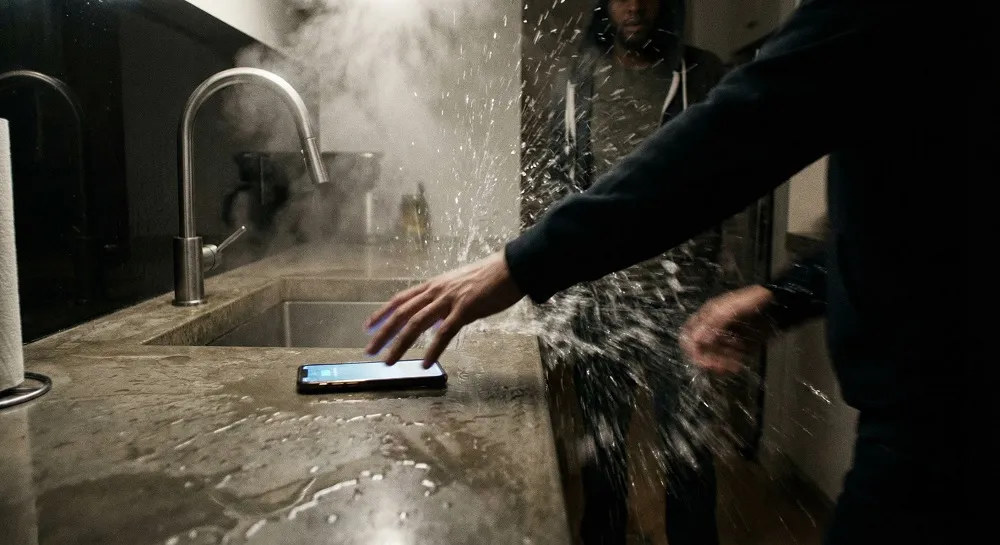
340,000 Emergency Home Service Searches Every Month Across GCC Capitals — And Three Businesses Get 90% of the Calls
Let me put the scale of this into perspective with numbers that most service providers in the region have never seen.
Across the six GCC capital cities — Riyadh, Abu Dhabi (and Dubai), Doha, Kuwait City, Manama, and Muscat — Google processes an estimated 340,000 monthly searches directly related to emergency and urgent home services. Plumbing. Locksmith. Electrical. AC repair. Glass replacement. Pest control. Water heater failure. Drain blockage. These are not planned appointments. These are crises. The person searching has a problem that needs solving within the hour, not next Thursday.
Now here is the number that should make every emergency service provider stop and think: Google’s own data shows that for local service queries with urgent intent, the top three Map Pack results receive between 87% and 93% of all clicks. Position four and below might as well not exist. Page two is a ghost town. For emergency searches specifically, the concentration is even more extreme because the caller is in a hurry. They do not shop around. They call the first credible option they see.
Let me break this down by city because the dynamics vary:
Riyadh: Over 92,000 monthly searches for emergency home services. The city’s population of 8.5 million generates enormous volume. Arabic queries dominate — “سباك الرياض الآن” (plumber Riyadh now), “فتح باب مقفل حي النرجس” (open locked door Al Narjis district), “كهربائي طوارئ شمال الرياض” (emergency electrician north Riyadh). About 72% of these searches happen on mobile. Peak hours are 9 PM to 2 AM and 6 AM to 8 AM — exactly when regular businesses are closed.
Dubai & Abu Dhabi combined: Approximately 108,000 monthly emergency service searches. English leads at roughly 61%, but Arabic and Hindi/Urdu searches combined cover the remaining 39%. “Plumber near me Dubai Marina,” “AC repair emergency Abu Dhabi,” “فني تكييف عجمان” (AC technician Ajman) — the language split creates three separate opportunities that most service providers only capture one of, if any.
Kuwait City: Around 47,000 monthly searches. Arabic is the dominant language here at nearly 68%. “نجار الكويت 24 ساعة” (carpenter Kuwait 24 hours), “فتح اقفال سيارات حولي” (car locksmith Hawalli), “سباك الأحمدي” (plumber Ahmadi). The concentration of population in a relatively small urban area means competition for Map Pack spots is intense.
Doha: About 28,000 monthly searches. The expat-heavy population means English queries slightly outpace Arabic — “emergency electrician Doha,” “plumber Al Wakrah 24 hours,” “مفاتيح سيارات الدوحة” (car keys Doha). The market is smaller but the average service fee is higher, making each search more valuable per click.
Manama: Roughly 18,000 monthly searches. Bahrain’s compact geography means nearly every service provider covers the entire island, but Google still prioritizes businesses closest to the searcher. “سباك المنامة” (plumber Manama), “locksmith Juffair,” “كهربائي الرفاع” (electrician Riffa).
Muscat: Approximately 22,000 monthly searches. Oman’s market is growing rapidly in digital adoption. “فني سباكة مسقط” (plumbing technician Muscat), “emergency AC repair Muscat,” “قفل باب بوشر” (door lock Bousher). Less competition than other capitals, meaning ranking opportunity is wider open.
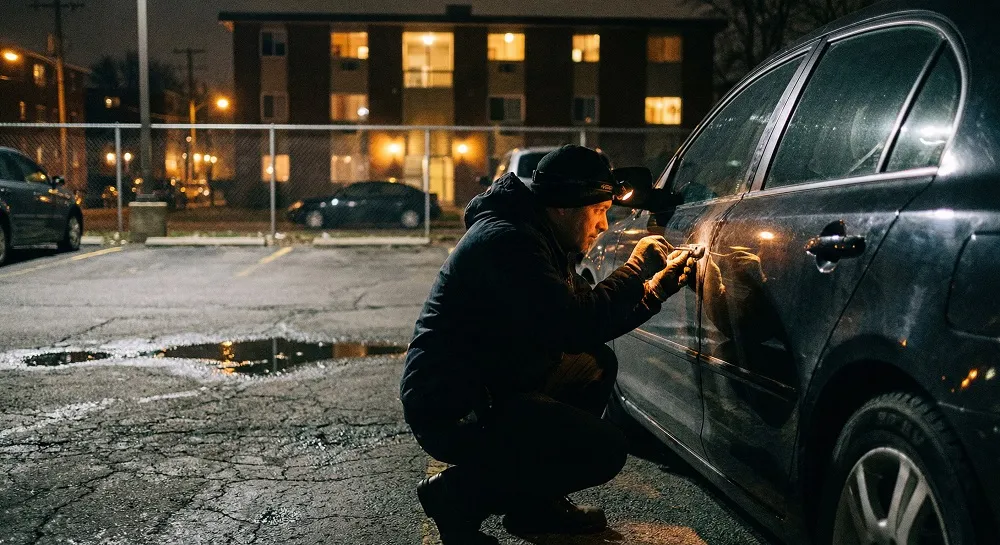
“Near Me Now” – Three Words That Changed Emergency Services Forever
Something shifted in how people search for urgent services around 2022 and it has only accelerated since. Google reported that searches containing “near me now” or “open now near me” grew globally by over 200% between 2020 and 2025. In the Middle East specifically, mobile searches with local intent make up 76% of all searches that result in a same-day action.
For emergency services, this trend is not gradual. It is the entire ballgame.
When someone searches “locksmith near me open now” at 11 PM in Al Qurum, Muscat, Google does four things almost simultaneously:
First, it checks the searcher’s GPS location to determine which businesses are physically closest.
Second, it filters for businesses whose Google Business Profile indicates they are currently open — this is why your operating hours must be set to 24/7 if you offer round-the-clock service, and why those hours must be accurate and never left on default.
Third, it evaluates which businesses have the strongest profile signals — review count, review rating, response rate, photo recency, post activity, category accuracy.
Fourth, it checks whether any of these businesses have a website that confirms the service the person is searching for, in the language they are searching in, for the location they are searching from.
All of this happens before the results load. The three businesses that pass all four filters appear in the Map Pack with a click-to-call button right next to their name. The ones that fail any filter — wrong hours, no reviews, no website, wrong category — disappear.
Voice search amplifies this even further. In homes across the GCC, people are saying “Hey Google, find me a plumber right now” in English and “يا غوغل ابيلي سباك الحين” in Gulf Arabic. Voice queries are almost always local, almost always urgent, and almost always result in a direct phone call to the first result. There is no scrolling in voice search. There is no “let me compare options.” There is only first place.
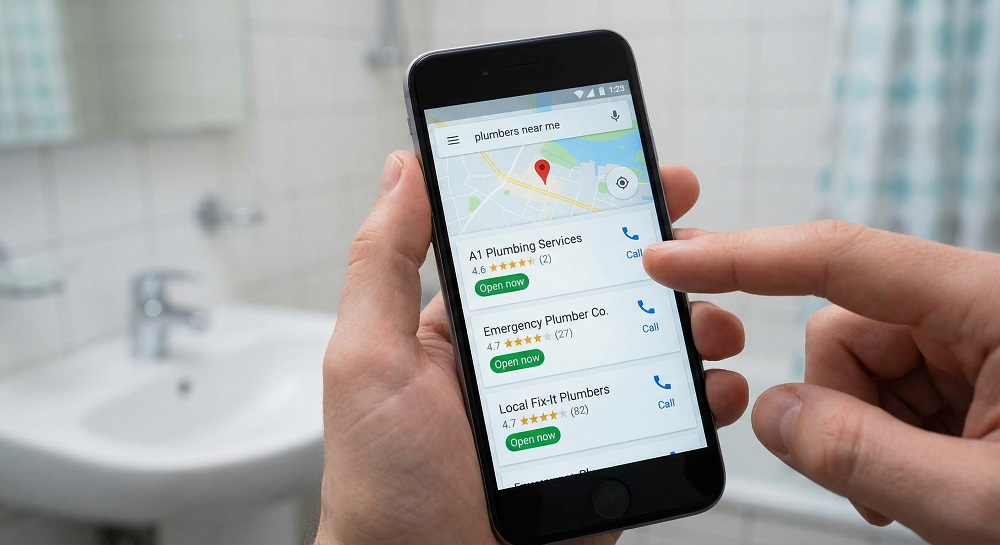
Your Google Business Profile Is Your Emergency Dispatch Center
For a restaurant, a slow week on Google might mean a few fewer reservations. For a law firm, it might mean one less consultation. For an emergency service provider, a poorly managed Google Business Profile means zero calls. Not fewer. Zero. Because the customer in crisis has no patience, no loyalty, and no time. They call whoever Google puts first.
This is why a Google Business Profile for an emergency plumber, locksmith, electrician, or AC technician is not a marketing asset — it is a dispatch system. And it needs to be managed like one.
Hours of operation must reflect actual availability. If you answer calls 24 hours a day, your profile must say 24 hours. Google suppresses businesses marked as “closed” from urgent search results. A locksmith in Hawalli, Kuwait who operates around the clock but whose GBP shows “closes at 10 PM” is invisible to every search happening after 10 PM. That is exactly when most locksmith calls happen.
Business categories need to be precise and multiple. Google allows primary and secondary categories. An emergency plumber should not just select “Plumber” — they should add “Emergency plumber,” “Drain cleaning service,” “Water heater repair service,” and any other relevant sub-categories. Each category matches a different set of search queries. More accurate categories mean more visibility across more search types.
Service area definition is where most emergency providers in Arab capitals get it wrong. Rather than listing the entire city, Google allows you to define specific neighborhoods and districts. A plumber in Riyadh who defines service areas as Al Olaya, Al Malqa, Al Yasmin, Hittin, Al Sahafah, and Al Narjis tells Google to show their business for searches originating from these specific neighborhoods. This granularity wins over a competitor who vaguely lists “Riyadh” as their service area.
Photos must show real work. Not stock images. Not logos repeated twelve times. Actual photos of your team, your vehicles, your tools in action, completed repairs. Google has confirmed that businesses with more than 100 photos receive 520% more calls than businesses with fewer than 10. For emergency services, the photos also build trust — a customer in distress needs to feel confident they are calling a real, professional operation, not a scam.
Google Posts should be published weekly with seasonal relevance. In summer across the Gulf, AC repair searches spike by 300-400%. A GBP post in June saying “24/7 emergency AC repair across Doha — average response time 35 minutes” captures attention at exactly the right moment. During Ramadan, plumbing issues increase due to heavy kitchen use — a post addressing this builds relevance and timeliness.
Click to Call: The Only Conversion That Matters — and How Most Service Providers Break It
In traditional e-commerce or service business SEO, a conversion might be a form submission, an email, or an add-to-cart action. In emergency services, there is only one conversion that counts: the phone call. Everything — your GBP, your website, your ads — exists for one purpose: to make someone tap that call button.
And yet, the number of emergency service providers across Arab capitals who make it difficult to call them is staggering.
Common failures we see:
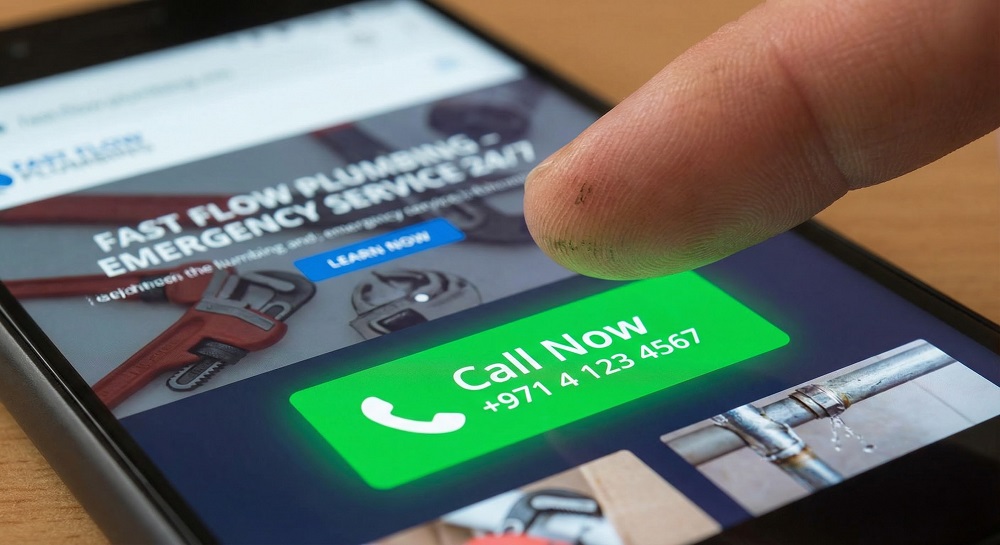
Phone number displayed as an image instead of clickable text. On mobile, this means the customer has to memorize the number, switch to the dialer, and type it manually. In an emergency, they won’t. They’ll go back and call the competitor with a tappable number.
No phone number visible above the fold on mobile. If someone has to scroll down your website to find how to call you, you have already lost. The phone number — as a click-to-call button — should be the most prominent element on every page of your site, fixed at the top of the mobile screen at all times.
WhatsApp-only contact. This is extremely common in the GCC. Many service providers prefer WhatsApp because it is convenient for them. But a customer with a burst pipe does not want to type a message and wait for a response. They want to call, hear a human voice, and know that someone is coming. Click-to-call must be a phone call, not a messaging redirect.
Phone number not matching across platforms. If your Google Business Profile shows one number, your website shows another, and your social media shows a third, Google loses confidence in your listing accuracy and suppresses your visibility. NAP consistency — Name, Address, Phone — is a foundational ranking factor for local SEO.
Technically, implementing click-to-call correctly requires a clickable tel: link in your website’s HTML, a sticky mobile header with the phone icon always visible, call tracking that doesn’t break the user experience, and schema markup that tells Google your phone number and availability hours. For businesses serving multiple emirates or cities, location-specific phone numbers (or at least a central dispatch number routed correctly) ensure Google matches the right number to the right local search.
Reviews in Crisis — Why a 4.7 Rating Beats a Full-Page Ad
Consider two scenarios that play out hundreds of times daily across GCC capitals:
Scenario A: A family in Al Gharrafa, Doha is locked out of their apartment at 9 PM. Google shows three locksmiths. One has 14 reviews at 3.9 stars. One has 43 reviews at 4.2 stars with the owner responding to half of them. One has 211 reviews at 4.7 stars with every single review answered within hours — including the negative ones where the owner apologized and offered to make things right.
Who gets the call? Not even a close contest.
Scenario B: An AC unit dies in a villa in Khalifa City, Abu Dhabi during August. Indoor temperature is climbing past 40°C. Google shows AC repair services. One has no reviews. One has 8 reviews from three years ago. One has 89 reviews from the past twelve months, recent photos of completed installations, and a Google Post from last week offering “same-day emergency AC repair.”
Again. Not a close contest.
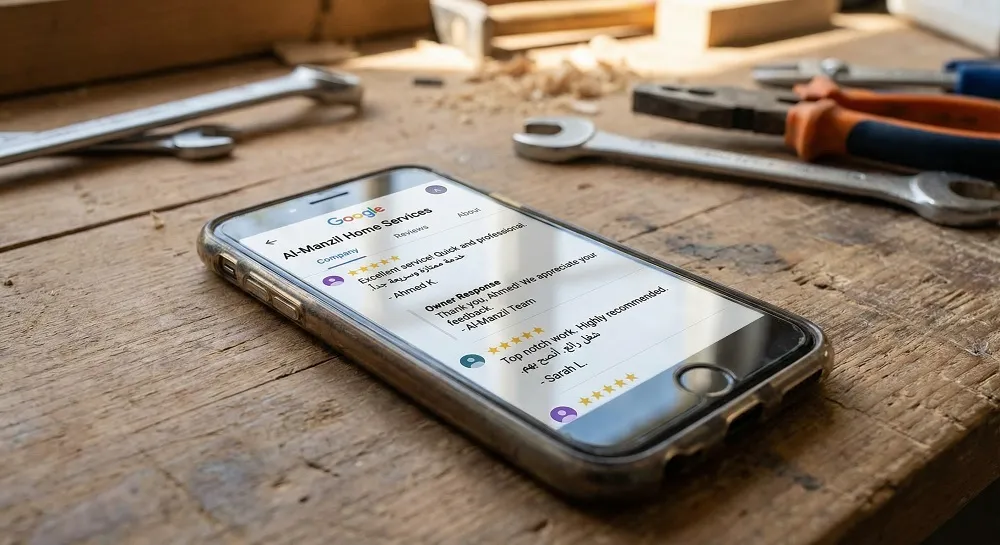
Reviews for emergency services carry disproportionate weight because the customer is vulnerable. They are letting a stranger into their home. They are trusting someone with their safety, their property, their comfort. The risk feels real. Reviews reduce that perceived risk faster than any website copy or advertisement.
Building reviews in the emergency services sector requires a simple post-service system. After every completed job, the technician sends a direct Google review link via SMS or WhatsApp. Not a generic “please review us” request, but a personalized message: “Thank you for trusting us with your AC repair today. If you were happy with the service, a quick review here helps other families in Abu Dhabi find reliable help: [link].” Conversion rates on these post-service requests typically run between 25% and 40%, meaning a business completing 20 jobs per week can accumulate 20-30 new reviews per month.
The Language Split No One Talks About in Home Services
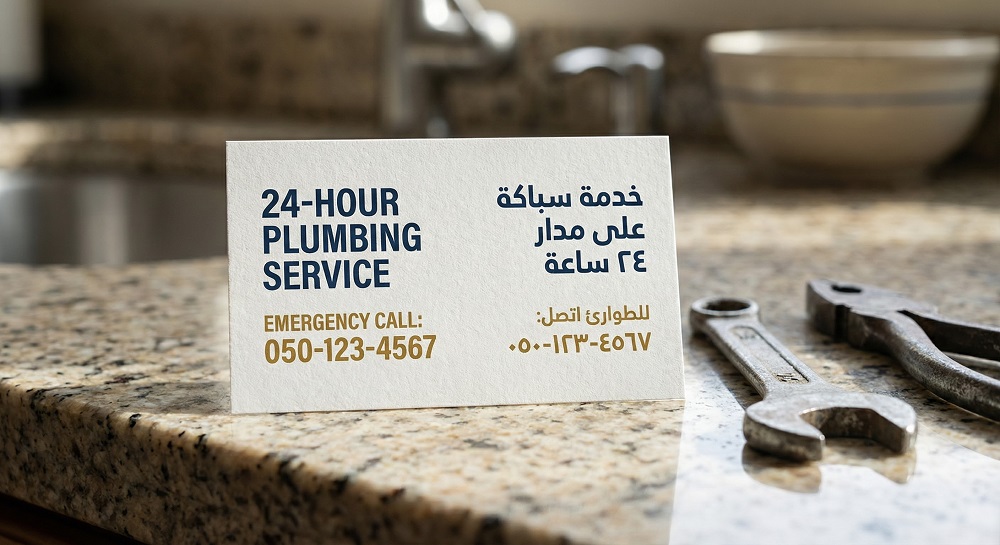
Emergency service providers in the GCC have a unique language challenge that differs from any other industry. In the same week, a plumber in Riyadh might receive a call from a Saudi family speaking Arabic, a Pakistani family speaking Urdu, an Indian family speaking Hindi or Malayalam, a Filipino family speaking English, and a Syrian family speaking Levantine Arabic. The customer base is fragmented by language in a way that restaurants, retailers, and professional services rarely experience to the same degree.
On Google, this fragmentation shows up clearly in search data:
In Kuwait City, “سباك” (plumber) gets searched 6,200 times monthly. “Plumber Kuwait” gets searched 2,800 times. Same service. Different audiences. Different language. Different search results page.
In Dubai, “locksmith near me” gets 4,100 monthly searches. “فتح اقفال دبي” (locksmith Dubai) gets 3,500. “चाबी वाला दुबई” in Hindi gets negligible Google search volume but represents a population of over 2.5 million Hindi-Urdu speakers who instead search in English as their second language.
What does this mean practically? A service provider who builds web pages in both Arabic and English — with native content targeting the actual search phrases in each language — captures both audiences. The Arabic page targeting “سباك طوارئ حي الملقا الرياض” and the English page targeting “emergency plumber Al Malqa Riyadh” can both rank simultaneously for their respective queries. This is not double the work — it is double the visibility from a single business.
For the Arabic content specifically, the dialect matters. Gulf Arabic search patterns differ from Egyptian or Levantine. A locksmith in Kuwait needs content that uses Kuwaiti phrasing like “بو مفتاح” alongside the formal “فتح اقفال.” A plumber in Jeddah needs “مواسرجي” as well as “سباك.” These colloquial terms appear in voice searches far more than in typed queries, making them essential for capturing the growing voice search segment.
11 PM Tonight, Someone in Your City Will Need You. Will Google Know?
Emergency service work is not like other businesses. You cannot schedule demand. You cannot predict which apartment complex will have a plumbing failure or which family will lock their keys inside their car. What you can control is whether your business appears at the exact moment those crises happen.
SEO Services Packages
Google Business Profile Packages
Web Design Packages
TripAdvisor & Hospitality Packages
Every night across Riyadh, Dubai, Doha, Kuwait City, Manama, and Muscat, hundreds of people reach for their phones in moments of genuine stress. Water damage spreading. Children crying at a locked door. An elderly person sitting in a sweltering apartment because the AC died. These are not casual browsing sessions. These are people who need help and will pay for it immediately.
The plumber who answers at that moment does not just earn a service fee. They earn a saved phone number. A future recommendation. A five-star review written in genuine gratitude. A customer who will call them first for every future issue, emergency or not.
But none of that happens if Google does not know you exist.
Your Google Business Profile needs to say you are open. Your phone number needs to be one tap away. Your reviews need to tell the next customer that you showed up fast and fixed the problem. Your website needs to confirm your service area, your availability, and your professionalism in the language your customer speaks.
The call is coming tonight. The only variable is whose phone rings.
Reach out today:
📞 +968 7922 9535
📧 seoingcc@gmail.com
🌐 SEOinGCC
You get all your planned work from word of mouth. Emergencies are different. When someone’s toilet overflows at midnight, they are not calling around asking friends for recommendations. They are Googling. The emergency segment of the market goes entirely to whoever dominates local search. If you are not there, you are leaving those jobs — and the higher emergency fees that come with them — to competitors.
A Google Business Profile alone can get you into the Map Pack, yes. But having a website behind it strengthens every ranking signal. It does not need to be complex. A fast, mobile-optimized site with your services, service areas, phone number, and a few photos of real work can be built affordably and will significantly boost your Map Pack position compared to competitors with no website at all.
Google’s review fraud detection has improved significantly in 2025. Report obviously fake reviews through Google’s review flagging system. Meanwhile, focus on accumulating genuine reviews through your post-service SMS system. Volume and recency of authentic reviews will outweigh a competitor’s fake reviews over time, especially as Google continues purging fraudulent reviews.
For emergency services, Google Local Service Ads (LSAs) — the “Google Guaranteed” ads — can deliver immediate calls while your organic rankings build. In cities where LSAs are available (currently expanding across the GCC), they appear above the regular Map Pack and carry a trust badge. Running LSAs while building organic SEO creates coverage across the entire search results page.