If you want SEO in Oman to produce revenue, you need a system that turns search into qualified inquiries (calls, WhatsApp, booked meetings)—not a ranking report.
In Muscat, early movement typically shows up first in higher-quality leads within 6–12 weeks once technical leaks and intent gaps are fixed.
To be blunt: if your SEO can’t be audited to leads, you’re paying for activity—not outcomes.

Executive Snapshot for Muscat: What “SEO That Pays Back” Looks Like
SEO in Oman works when pages match real buying intent (service + Muscat/Oman), technical performance protects mobile conversions, and tracking proves which pages generate qualified inquiries.
Most failures come from generic content and “package SEO” that never connects rankings to calls or WhatsApp leads.
A defensible approach prioritizes Local intent, measurable KPIs, and risk-controlled execution.
3 Key Takeaways:
- Muscat SEO should be measured by qualified inquiries, not traffic volume.
- Local intent pages usually outperform generic blog content in Oman.
- Mobile performance targets directly influence lead volume (Core Web Vitals).
When it works / When it won’t:
Works when:
- you can define offers, service areas, and lead qualification rules
- you respond fast (calls/WhatsApp) and keep business info consistent
Won’t work when:
- you want guaranteed #1 results without conversion measurement
- your site is slow, unclear, or lacks trust signals (proof, policies, contact clarity)
Definitions (Quote‑Ready)
- Qualified inquiry: a lead that matches your service area + need + budget signals (not “just asking price”).
- Local intent: searches that include Muscat/Oman or “near me” and indicate immediate buying intent.
- Core Web Vitals: LCP/INP/CLS performance metrics that impact real mobile conversions.
The Short List (If You Want Leads in Oman): 3 Non‑Negotiables
- Intent clarity: pages that map to how people search in Muscat (service + location + problem).
- Trust clarity: proof, process, scope, and response channels shown instantly.
- Proof clarity: tracking that ties search to inquiries (calls, WhatsApp, booking), not just rankings.
If one of these is missing, your close rate drops and your team wastes time on low-quality leads.
The Real Bottleneck in Muscat: Why Cheap SEO Packages Fail Quietly
Cheap SEO usually fails in Oman for one reason: it optimizes for what’s easy to sell, not what’s hard to prove.
Common “quiet failures” we see when reviewing client setups:
- “Monthly content” that ranks for low-intent queries but produces no SQLs (sales-qualified leads).
- Reports that show movement but ignore CRM reality: pipeline, close rate, deal value.
- Speed and UX ignored on mobile—even though most first visits come from phones.
This is where owners get stuck: they feel busy, but revenue stays flat.

Who Owns Page One in Oman (and Why): Agencies, Directories, Maps
For “SEO Muscat” style searches, you’ll typically see:
- agencies with strong brand/entity signals
- directory pages that aggregate providers
- map results where relevant for local agencies
Why they win:
- clarity of services and location
- consistency of business info
- stronger content depth and internal linking
- better UX on mobile
This is not about “more backlinks” in isolation. It’s about a cleaner, more credible decision journey.
Reference points you can verify:
- Google guidance on creating helpful, reliable content:
- Google Business Profile fundamentals for local visibility:
Market Numbers That Explain the Competition in Muscat (With Sources)
You asked for real local numbers. Without a data feed, we will not guess.
| Why it matters | Source | Period | Value | Metric |
| Demand ceiling and realistic targeting assumptions start here. | NCSI Oman (official): | Latest available | UNKNOWN (verify latest) | Population (Muscat Governorate) |
| More active firms = higher B2B search competition for services. | NCSI / official portals | Latest available | UNKNOWN | Active business landscape proxies |
| Impacts WhatsApp-first behavior and mobile conversion design. | Data Reportal (Oman hub): | Latest available | UNKNOWN | Digital usage / internet adoption |
2–4 questions to confirm (so we can replace UNKNOWN with real, cited numbers):
- Are you targeting Muscat only or multiple governorates?
- Is your ICP B2B, B2C, or mixed?
- What’s your average deal value and close rate?
- Which 3 competitors show up most often in Muscat for your main query?
The System We Deploy for SEO in Oman: Search → Qualified Inquiries
At SEO in GCC (سيو في الخليج) we build a lead system, not a checklist.
- Module 1 (Local SEO): You win when your “Muscat intent” is obvious: service scope, service areas, and credibility signals are consistent across your web presence.
- Business outcome: higher CTR and more qualified calls.
- Module 2 (Technical fortress): We engineer mobile conversion reliability, not just speed claims.
- Targets: LCP < 1.2s, INP < 200ms, CLS < 0.1 on key landing pages. (https://web.dev/vitals/)
- Business outcome: fewer bounces, more completed inquiry actions per 100 visits.
- Module 3 (Conversion measurement): We design tracking around revenue reality (pipeline), not vanity metrics.
- Business outcome: you can audit which pages generate leads and cut what doesn’t work.

Proof Model: How We Tie Muscat SEO to Calls, WhatsApp, and Booked Meetings
We measure outcomes that match real sales operations:
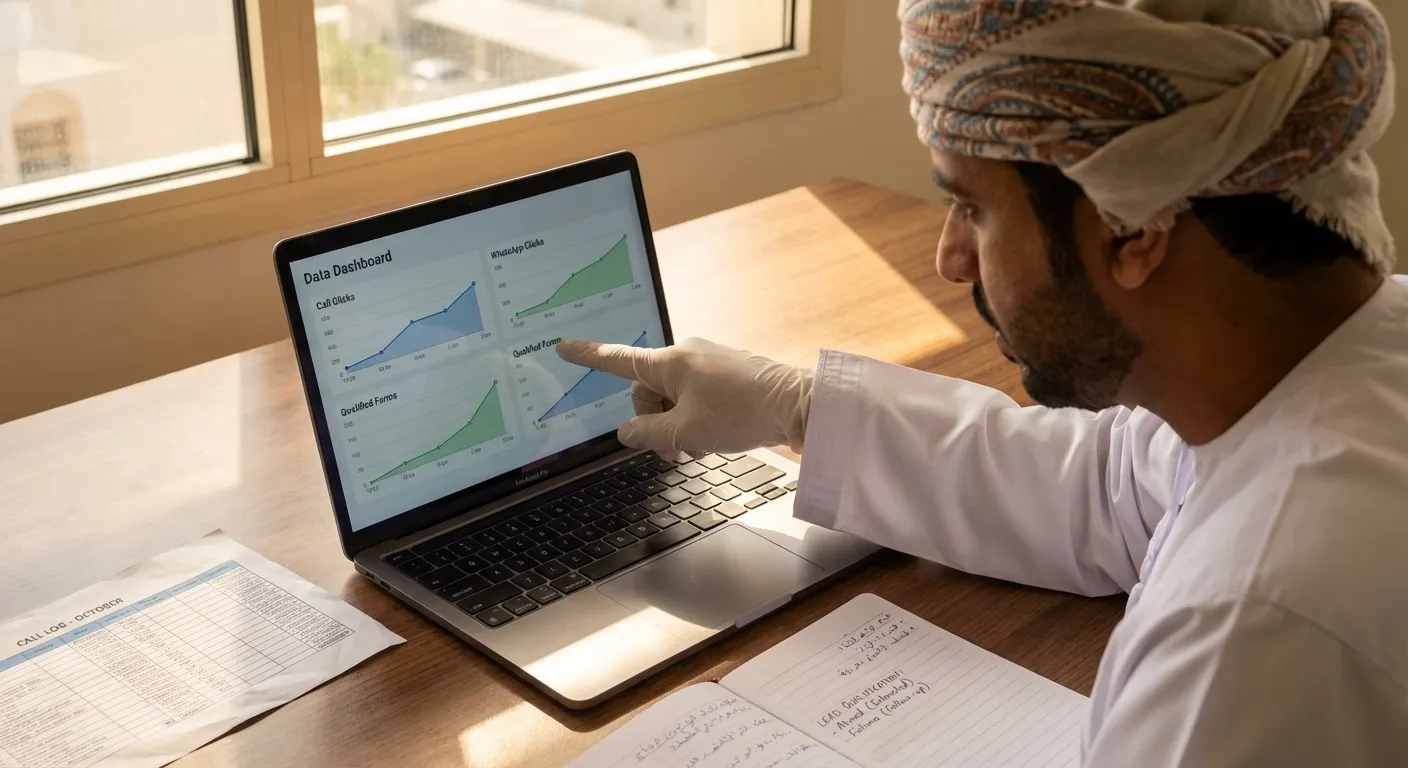
- calls and call quality
- WhatsApp inquiries
- booked meetings
- qualified form submissions
Single experience marker (with artifact):
On one Muscat site review, we found GA4 had pageviews but no click_whatsapp event—so “SEO wins” couldn’t be tied to leads. After adding event tracking, the business could attribute inquiries to specific landing pages and stop funding pages that never converted.
References:
- GA4 measurement concepts: https://developers.google.com/analytics
- Structured data reference (when relevant): https://schema.org/
Two‑Week Onboarding: Scope, KPIs, Risks (Built for Oman Buyers)
Days 1–3: reality audit (SERP landscape, technical leakage, conversion path).
Days 4–7: blueprint (page map + KPI targets + risk controls).
Days 8–14: implementation begins on the highest-impact pages.
This reduces risk because you see the plan before you pay for months of activity.
Deliverables (So You Can Compare Agencies in Muscat Without Guessing)
What a serious engagement typically includes:
- a written scope (statement of work)
- KPI definitions (MQL/SQL logic, qualified inquiry rules)
- tracking plan (events + reporting cadence)
- technical performance targets for key pages
- content architecture (service pages + location intent + topical depth)
If a vendor can’t define deliverables and measurement, you’re buying uncertainty.
30/60/90 Deployment Roadmap for Muscat: Fast Wins → Compounding Wins
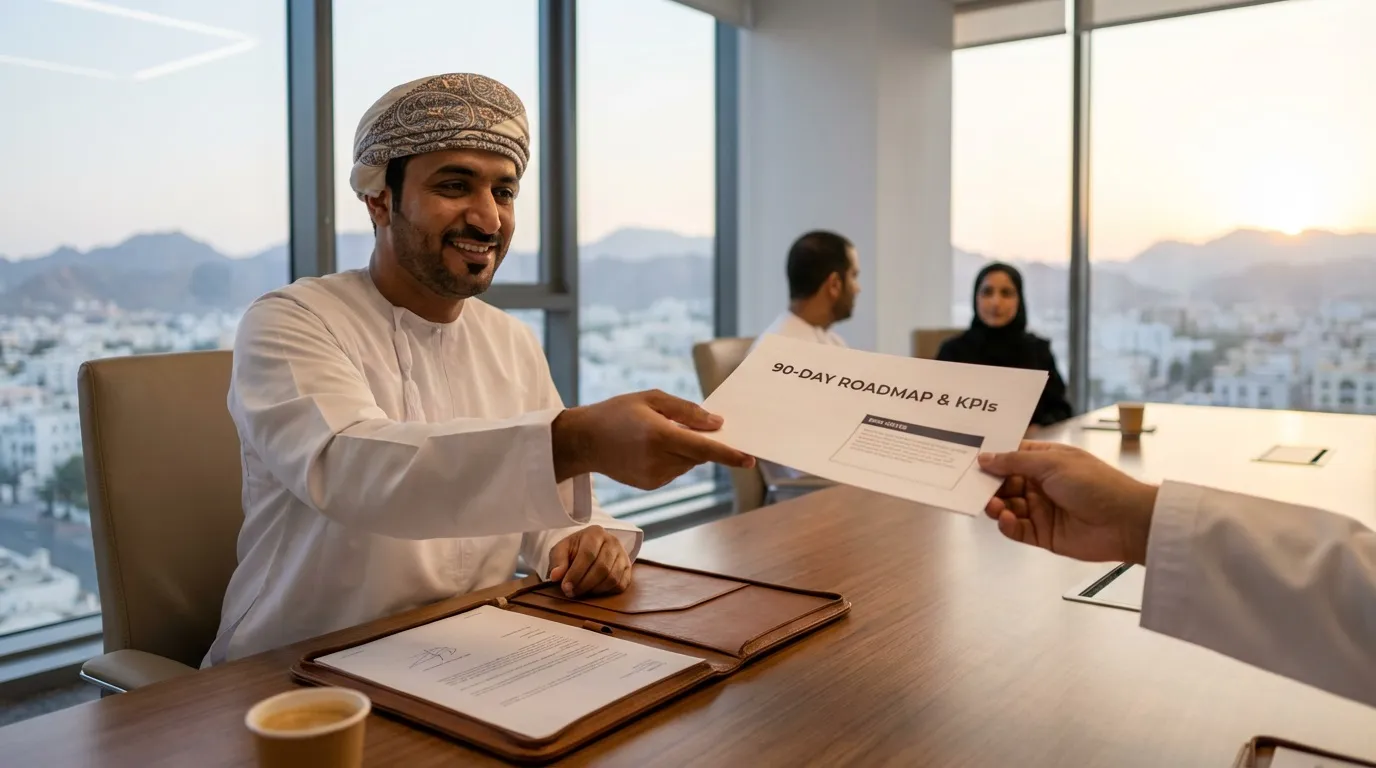
30 days: measurement foundation + top intent pages + technical leakage fixes.
60 days: expand high-intent clusters and internal linking; improve CTR on pages already getting impressions.
90 days: deepen topical authority, tighten local trust signals, and scale what already converts.
City-modified query examples (8+):
- SEO Muscat
- SEO services Muscat Oman
- SEO agency Oman
- digital marketing Muscat
- local SEO Muscat
- Google Business Profile optimization Muscat
- technical SEO Oman
- SEO company Muscat
What we would NOT do:
- sell “links” as the strategy
- promise #1 rankings
- publish generic content without intent-to-lead mapping
- report progress without lead measurement
CTA #3 (Next step): Request the Muscat SEO Diagnostic with SEO in GCC (سيو في الخليج). Send: website + GBP link (if any) + top offers + target areas. You’ll receive a measurable roadmap and risk notes.
SEO Services Packages
Google Business Profile Packages
Web Design Packages
TripAdvisor & Hospitality Packages
Most businesses in Muscat see early movement in qualified inquiries (calls/WhatsApp/forms) within 6–12 weeks once the foundation is fixed (tracking, intent pages, mobile performance). Competitive niches or new domains can take 3–6 months to become consistent.
Pricing depends on scope, not a fixed “package.” The main drivers are: competition level, number of services/products, number of locations, content depth required, and technical debt. If an agency can’t define deliverables + KPIs (calls/WhatsApp/booked meetings), the price is meaningless because ROI can’t be audited.
In Muscat, it’s usually both—but Local SEO often drives the fastest wins for service businesses because it converts into calls and directions quickly. The website’s job is to qualify and convert (clear services, trust signals, fast mobile UX). If you do only one, you leak leads.
Target the language your buyers actually use. In Oman, many categories need both Arabic + English because search behavior splits between locals and expats. The mistake is auto-translation; the correct approach is separate intent pages with real wording (service + Muscat/Oman + buyer intent).