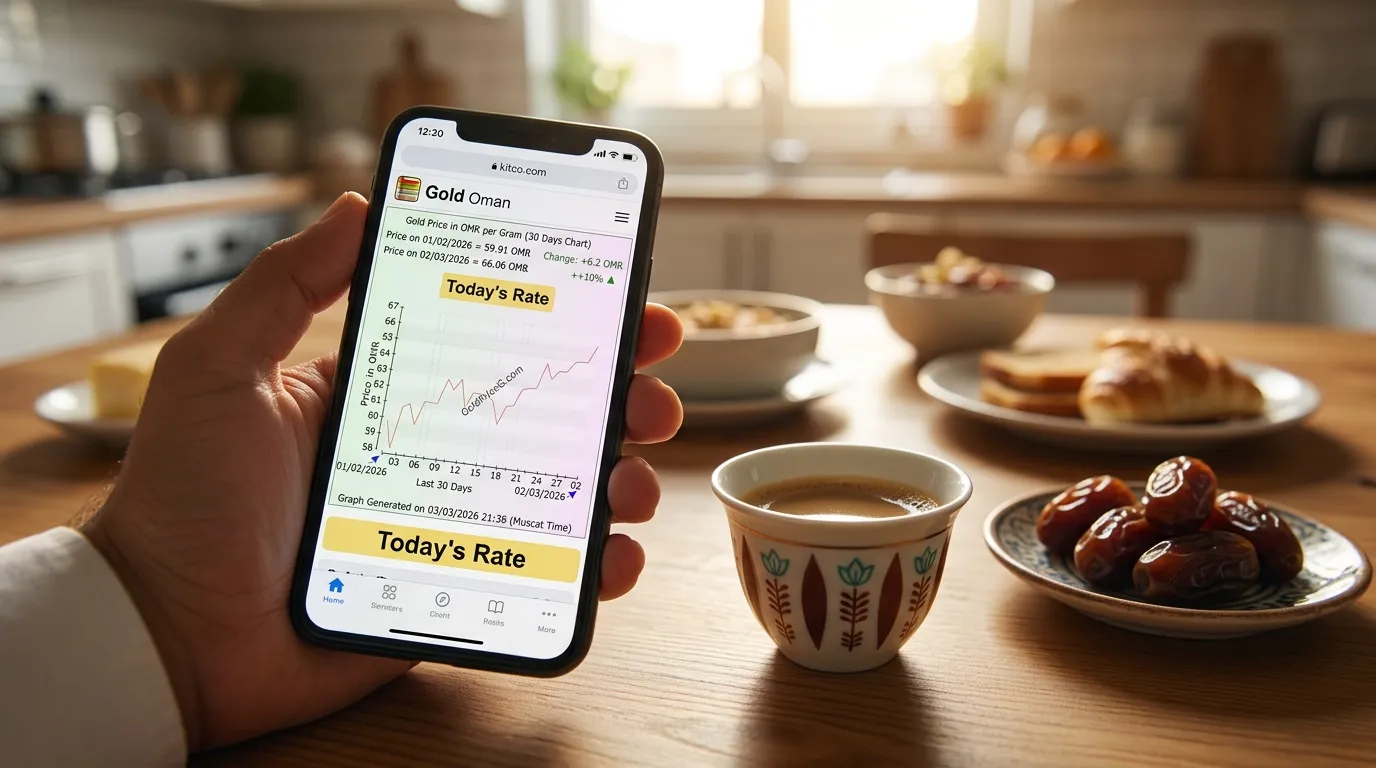
124,000 People in Oman Google the Gold Price Every Single Month. Then What?
Open any phone in any household in Muscat at 8 AM. Before the coffee is poured, before the children are dressed for school, someone in that home has already checked the gold price. It is a reflex. A daily habit embedded so deeply in Omani and Gulf culture that it functions more like checking the weather than monitoring a financial market.
“Gold price Oman today.” “سعر الذهب في عمان اليوم.” “Gold rate Muscat.” “سعر غرام الذهب ٢٢ عمان.”
These four search variations alone account for over 124,000 monthly Google searches originating from Oman. That number does not include the thousands more who check through apps, bookmark financial sites, or ask Google Assistant for the live rate while driving to work on Sultan Qaboos Highway.
Now follow the chain. The person who checks the gold price is not checking it academically. They are checking it because they are about to buy, are considering buying, or are mentally tracking the market until the price dips to their target. These are pre-purchase signals. Every single one of these 124,000 monthly searches represents a person who has gold on their mind. A person who, when they decide to buy, will need to choose a jeweler.
And here is where the chain breaks.
The same person who typed “gold price Oman today” at 8 AM will type “gold shop near me” or “أفضل محل ذهب مسقط” at some point in the following days or weeks. When they do, what appears? A handful of Google Business Profiles — most with under 20 reviews, stock photos or no photos at all, and zero product information. No website showing inventory. No indication of which shop carries 22-karat Indian-style sets versus 21-karat Gulf designs versus 18-karat Italian contemporary pieces. No pricing transparency. No trust signals beyond a pin on a map.
The largest pre-purchase audience in all of Omani retail — over 124,000 monthly searches — funnels into a buying decision that Google cannot properly guide because the shops themselves have given Google nothing to work with.
The Seven-Day Window Before an Omani Wedding. Seven Days Where Google Sends Brides Nowhere
Forget general gold shopping for a moment. Focus on the single highest-value transaction in jewelry retail: bridal gold.
In Omani wedding tradition, gold is not an accessory. It is a structural element of the marriage itself. The mahr (dowry) frequently includes gold sets — necklace, earrings, bracelet, ring — valued between 2,000 and 15,000 OMR depending on family expectations and regional customs. In Dhofari weddings, the gold component can exceed 20,000 OMR. Beyond the mahr, the bride’s family often purchases additional sets for the wedding night, for the milkah ceremony, and for daily wear after marriage.
Oman records approximately 18,000-20,000 marriages annually, according to the National Centre for Statistics and Information. If even half of those involve bridal gold purchases averaging 5,000 OMR — a conservative estimate — the bridal gold market alone represents roughly 50 million OMR per year. This is not a segment. This is the foundation of the jewelry business in Oman.
And how do families prepare for these purchases? In 2026, the process begins on a phone.
“طقم ذهب عروس عماني” (Omani bridal gold set) — 380 searches/month. Nobody in Muscat ranks for this.
“Gold set for wedding Oman price” — 290 searches/month. Results: Indian jewelry e-commerce sites and UAE retailers.
“أفضل محل ذهب للعرائس مسقط” (best gold shop for brides Muscat) — 210 searches/month. The Map Pack shows three results with minimal reviews and no bridal-specific content.
“21 karat gold set Muscat” — 170 searches/month. Not a single Muscat jeweler has a dedicated page for 21k bridal sets.
The mothers, sisters, and brides searching these terms are not casually browsing. They have a wedding date. They have a budget. They need to compare designs, understand pricing per gram, evaluate craftsmanship, and choose a jeweler they trust — all within a compressed timeline, often 7 to 21 days before the ceremony. The jeweler who provides this information online earns not just one sale but the social network effect of an Omani wedding, where every female guest examines the bride’s gold and asks where it came from.

Gold Souq Muttrah: 83 Shops in 200 Meters. Google Can Distinguish Approximately Four
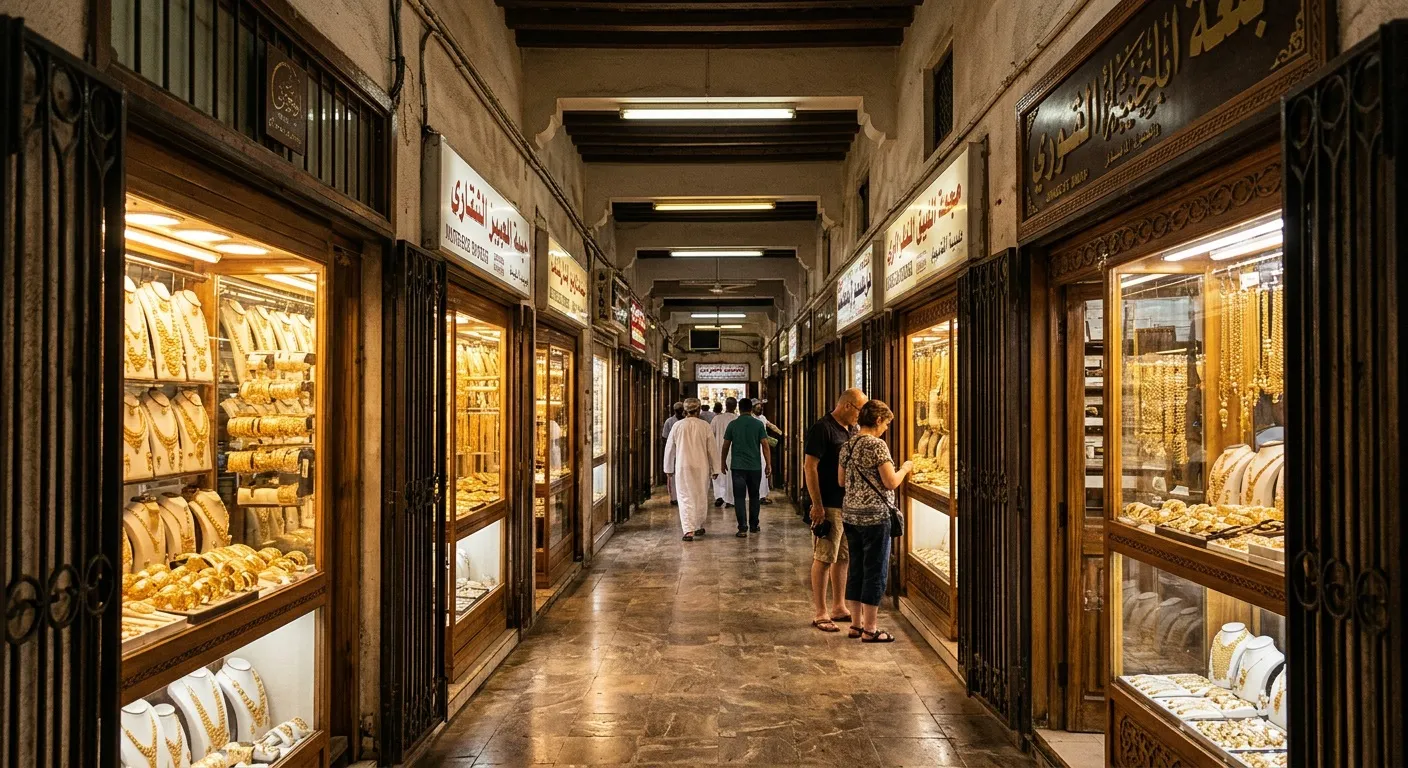
Walk through the gold section of Muttrah Souq on any weekday afternoon. The density is astonishing. Shop after shop, window after window, glowing with 22-karat and 21-karat gold under halogen spotlights. Indian-style temple jewelry next to Gulf-design layered necklaces next to Italian horn pendants next to Omani traditional silver khanjar brooches. Each shop has its identity, its specialty, its loyal clientele built over decades.
A jeweler at the eastern end of the souq specializes in Keralite bridal sets — the heavy, intricately carved necklaces and jhumka earrings favored by the South Indian community in Oman. His craftsmanship draws customers from as far as Sohar and Salalah. He has never appeared in a Google search result.
Three doors down, a family-run shop focuses on Omani traditional designs — the wide cuff bracelets with geometric engraving, the crescent pendants, the gold-dipped khanjar miniatures given as National Day gifts. Tourists who find this shop leave with pieces they cannot find anywhere online. The shop has no Google Business Profile.
Across the corridor, a larger establishment carries contemporary diamond-set pieces alongside classic Gulf gold. The owner invested 12,000 OMR in renovating the storefront last year. He did not invest 200 OMR in a basic website. His renovation is visible to the people walking past his door. A website would have been visible to every person in Oman searching for what he sells.
Out of the estimated 83 gold and jewelry shops in the Muttrah Souq area, I could identify only four with complete Google Business Profiles — meaning profiles with photos uploaded by the business, correct operating hours, a phone number that connects, and more than 10 reviews. Four out of 83. The remaining 79 are either unclaimed, incomplete, or entirely absent from Google Maps.
For tourists — and Muttrah Souq is the single most visited tourist attraction in Muscat — this creates a bizarre experience. Travel blogs and guidebooks say “visit the gold souq.” The tourist arrives and faces 83 identical-looking storefronts with no way to distinguish quality, specialty, or reputation. They wander, feel overwhelmed, and either buy from whoever greets them most aggressively at the entrance or leave without purchasing because the decision felt random rather than informed.
The four shops with proper Google profiles? They appear when that tourist searches “gold souq Muttrah best shop” from their hotel the night before. They get the pre-planned visit. They get the intentional buyer. They get the review afterward. The other 79 get whatever foot traffic chance delivers.
Inside the Malls: Where Professional Displays Meet Amateur Digital Presence
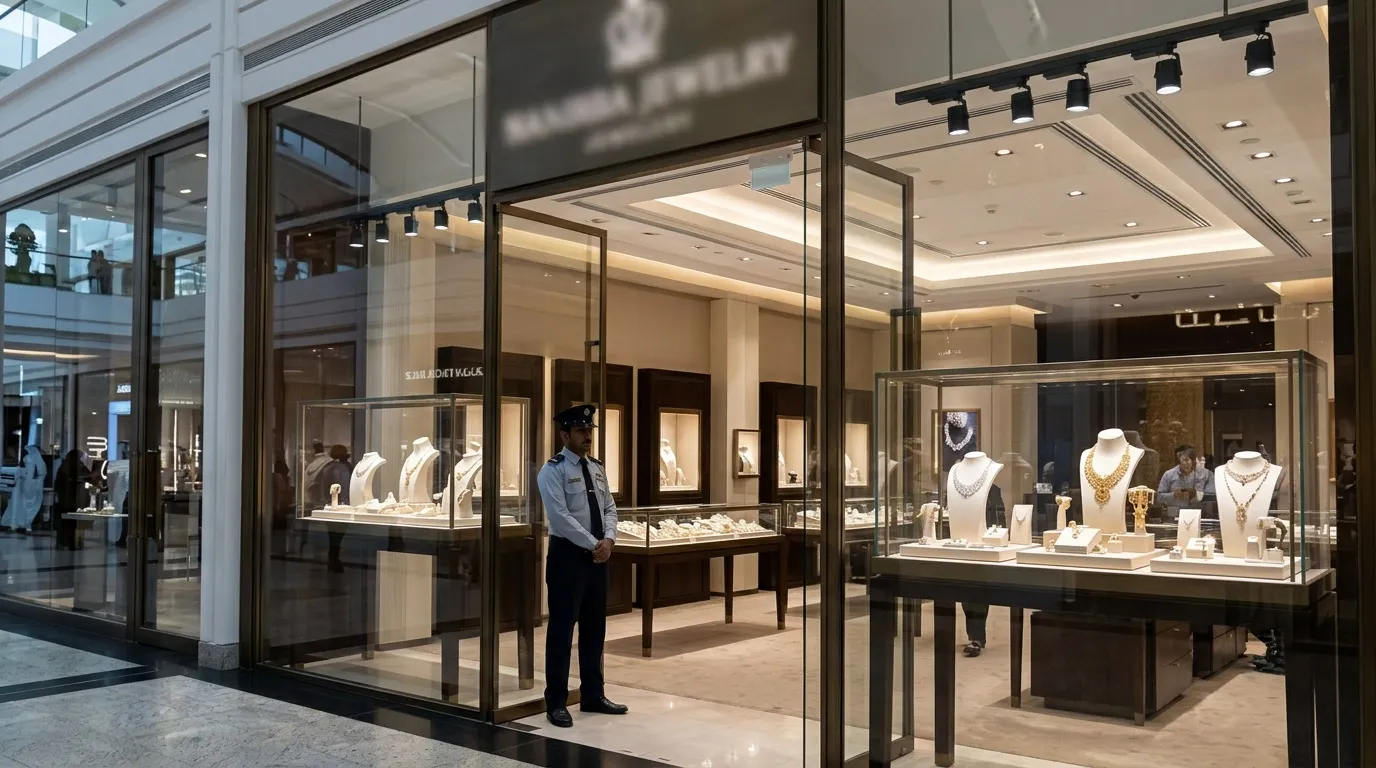
Shift from the souq to the structured retail environment. Gold and jewelry shops in Muscat’s malls operate in a different universe visually — marble floors, security cameras, branded display cases, uniformed staff, POS systems, and corporate presentation. But their digital presence is almost indistinguishable from the souq shops with no signage.
I spent a Tuesday visiting jewelry retailers across four malls. Not as a customer. As someone looking at their Google existence from the parking lot before walking in.
Mall of Oman — Al Seeb: Three dedicated jewelry stores on the ground floor. The largest carries Malabar Gold, one of the biggest jewelry chains in the Gulf. Malabar’s national brand does rank in Google for generic terms, but the specific Mall of Oman branch profile? Last photo uploaded: September 2024. Google Posts published: zero in 2025 or 2026. Branch-specific promotions visible on Google: none. An independent jeweler two units away had a Google profile marked as “Temporarily closed” — it has been open continuously since 2020.
City Centre Muscat — Qurum: The jewelry cluster near the central atrium includes Joy Alukkas, Kalyan Jewellers, and two independent Omani-owned gold shops. Joy Alukkas and Kalyan have national-level SEO from their corporate marketing, but even these large chains show weak branch-specific optimization. The independent shops effectively do not exist on Google. One has a profile with the business name misspelled.
Oman Avenues Mall — Al Ghubra: Two jewelry retailers. One had a single Google review — from 2022, written by what appears to be the owner’s friend. The other had no profile whatsoever. Combined retail space: approximately 140 square meters. Combined monthly rent: estimated 1,600-2,200 OMR. Combined digital presence: functionally zero.
Al Araimi Boulevard — Bausher: A boutique jeweler here carries stunning contemporary designs — clean lines, minimal settings, pieces that would photograph beautifully for Instagram and Google alike. Four employees on the floor during my visit. The shop’s Google Business Profile showed the correct address, phone number, and hours — nothing else. No photos. No products. No posts. No reviews. A digital ghost occupying a physical space.
The collective annual rent paid by jewelry retailers across Muscat’s malls likely exceeds 3 million OMR. The collective investment in Google visibility by these same retailers is approximately the cost of a single gold bangle.
Trust Is the Entire Transaction. Google Reviews Are Where Trust Lives Now
Gold is different from every other retail product in one fundamental way: the trust threshold is exponentially higher. When a customer buys a shirt, a bad purchase costs 15 OMR and mild disappointment. When a customer buys a gold necklace, a bad purchase costs 800 OMR and genuine distress — plus the social consequences of gifting substandard jewelry at a wedding or Eid gathering.
Customers buying gold need to trust the purity claim (is this really 22k?), the weight accuracy (is the scale calibrated?), the craftsmanship quality (will this clasp hold?), the pricing fairness (am I paying above market rate per gram?), and the after-sale policy (can I exchange or return?). In the past, this trust was built through repeat visits, family connections, and community reputation. In 2026, it is built — or destroyed — on Google.
A gold shop in Muscat with 140 Google reviews averaging 4.6 stars, including reviews that specifically mention “honest weight,” “fair making charges,” “showed hallmark certificates,” and “my family has been buying here for 10 years” — this shop has built a trust fortress that no marketing budget can replicate. A customer reading these reviews before visiting has pre-decided to trust this jeweler. The sale is 70% closed before they walk through the door.
Contrast this with a jeweler that has 3 reviews — one of which complains about being overcharged on making charges, with no response from the business. Every potential customer who Googles this shop and sees that unanswered complaint walks the other direction. Literally. They physically walk to the competitor whose Google reviews told them a more reassuring story.
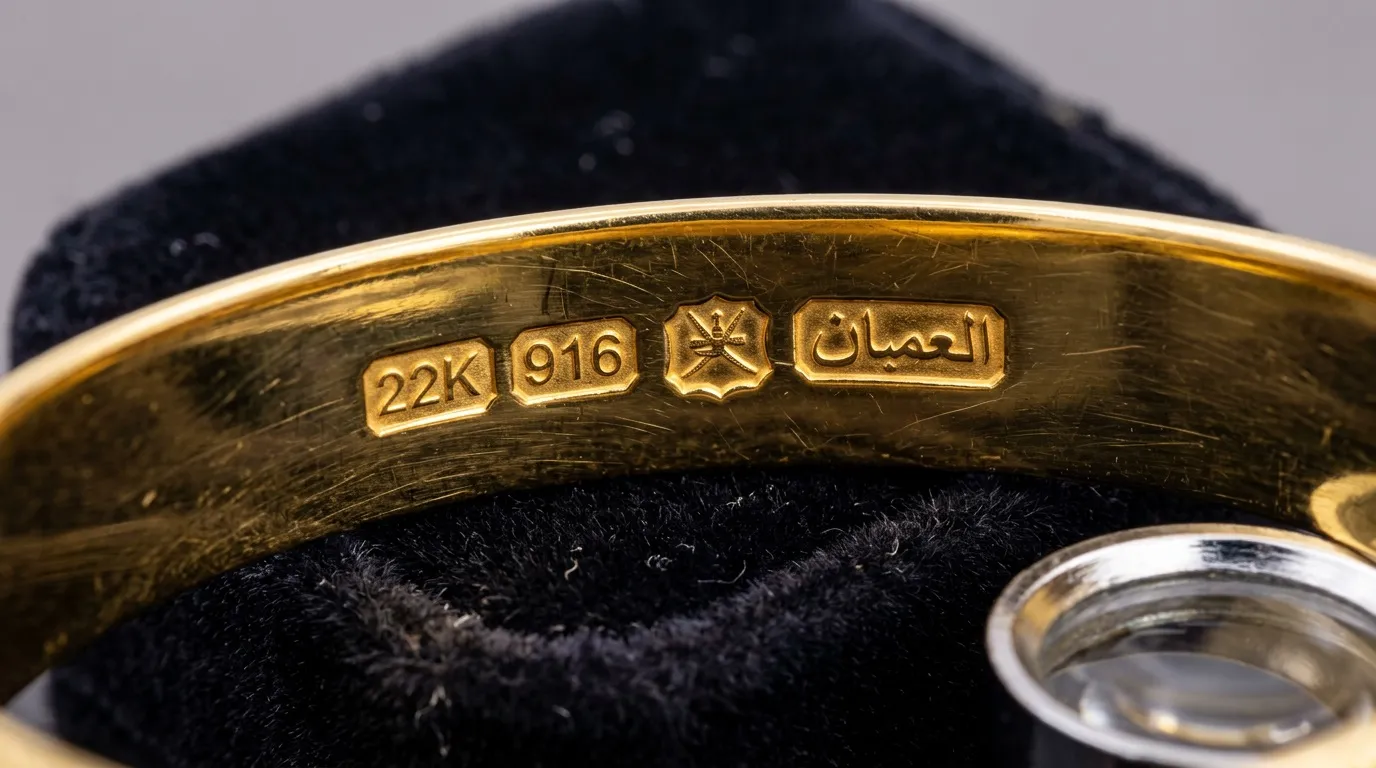
Oman’s Public Authority for Consumer Protection (PACP) requires gold hallmarking and assaying, which gives Omani consumers a regulatory framework for purity verification. But consumers do not check PACP databases. They check Google. A jeweler who mentions “all pieces hallmarked by Oman Assay Office” in their Google Business Profile description, and who has customer reviews confirming this, satisfies the trust requirement instantly. A jeweler who assumes customers trust them simply because their shop exists in a mall does not understand how trust formation works in 2026.
The Gold Rate Page: A Traffic Engine That No Jeweler in Muscat Has Built
Here is a strategy so obvious that its absence across the entire Omani jewelry market borders on absurd.
124,000 monthly searches for gold prices in Oman. Every single one of those searches is a person interested in gold. A significant percentage of those people will buy gold within the next 30 days. And not a single jeweler in Muscat has created a page on their own website showing daily updated gold rates.
Think about what this page would do:
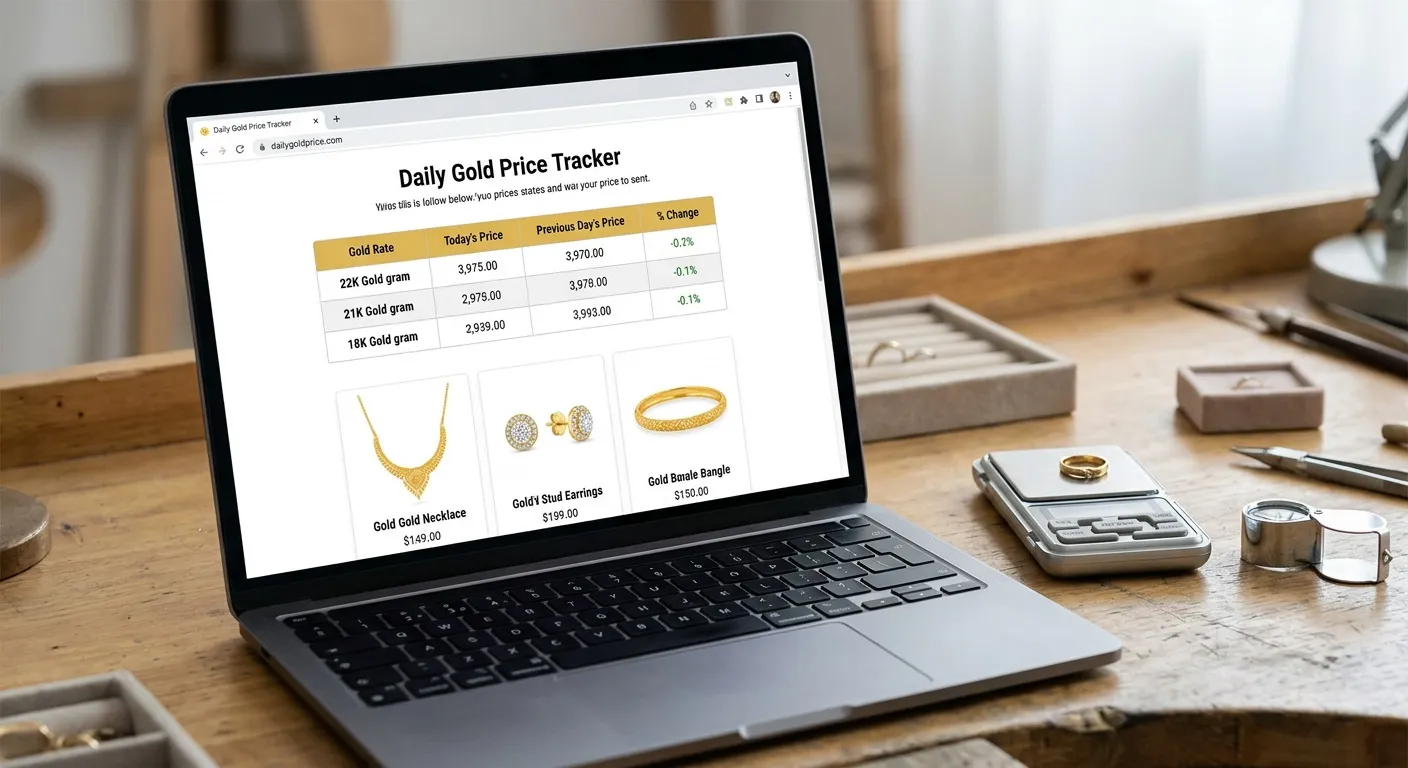
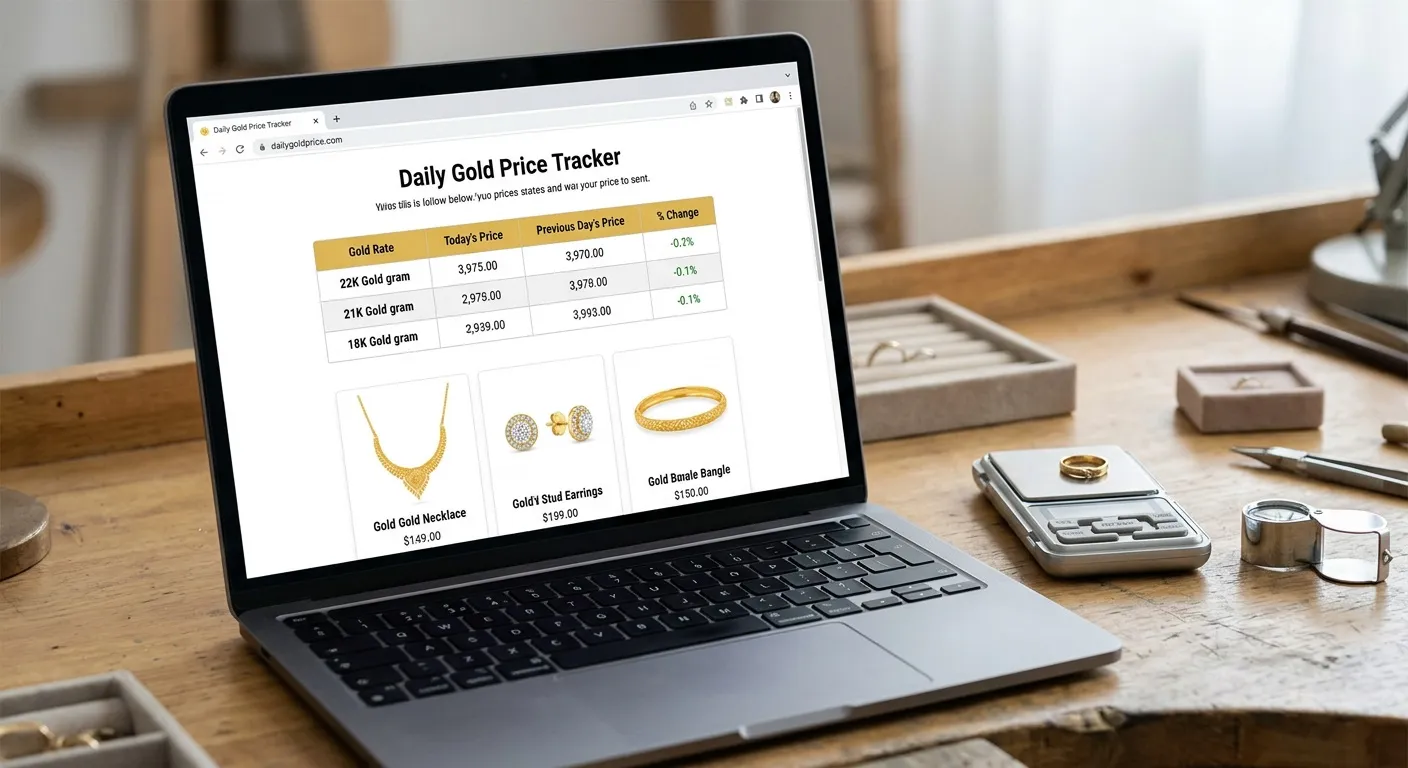
A jeweler in Qurum builds a “Gold Price in Oman Today — 22K, 21K, 18K Live Rates” page. The page updates daily (this can be automated through a simple API connection to a gold price data feed). The page shows the current per-gram price for each karat, compares today’s price to yesterday and last week, and includes a brief note about market trends.
Below the price table, the page shows “Our Collection at Today’s Rates” — linking to the shop’s product pages with approximate pricing based on current gold prices and making charges. A 22k necklace weighing 18 grams at today’s rate of 24.8 OMR/gram equals approximately 446 OMR in gold value, plus making charges.
This single page targets every variation of “gold price Oman” — a keyword cluster worth 124,000 monthly visits. Even capturing 2% of that traffic delivers 2,480 monthly visitors to your website. Visitors who are already thinking about gold. Visitors who now see your collection, your pricing, your reviews, your location. Visitors who drive to your shop because you converted their price-checking habit into a shopping visit.
No jeweler in Muscat has this page. The top results for “gold price Oman today” are generic financial sites with no connection to any physical retailer. The opportunity to own this search term — the single highest-volume commercial keyword in Oman’s jewelry sector — is sitting unclaimed.
Khanjar, Omani Silver, and the Tourist Purchase Nobody Is Capturing Online
Beyond gold, Oman has a centuries-old tradition of silver craftsmanship that generates its own Google search demand — almost entirely from tourists and collectors.
The Omani khanjar — the curved ceremonial dagger that appears on the national flag and is worn at formal occasions — is the country’s most iconic cultural artifact. Silver khanjars range from 30 OMR for simple tourist souvenirs to 3,000+ OMR for museum-quality handcrafted pieces with ornate scabbards and silver filigree. Maria Theresa thaler coins, traditional Bedouin jewelry, silver hirz (amulet) cases, and engraved cuff bracelets complete the category.
Tourists actively search for these items before and during their visits:
“Buy Omani khanjar Muscat” — 210 searches/month.
“Traditional Omani silver jewelry” — 180 searches/month.
“خنجر عماني فضة” (Omani silver khanjar) — 140 searches/month.
“Best place to buy silver Oman” — 160 searches/month.
“Omani jewelry souvenirs” — 190 searches/month.
These searches peak during tourist season (October-March) and spike again around Oman National Day in November when khanjar-related content circulates in media.
The shops in Muttrah Souq and in Nizwa Souq that specialize in traditional Omani silver have a product that cannot be purchased authentically anywhere else in the world. This is not like gold where the same 22k chain can be bought in Dubai, Bahrain, or Mumbai. A hand-forged Omani khanjar with a rhino horn handle and silver filigree scabbard from a craftsman in Nizwa is a unique cultural product available only in Oman. Its exclusivity is absolute.
And yet, tourists searching for it on Google find Pinterest boards, stock photography, Wikipedia articles about the khanjar, and travel blogs with no links to actual shops. The product with the highest cultural exclusivity in Omani retail has the lowest online visibility. The craftsman who spent 80 hours forging a scabbard loses to a souvenir shop in Dubai selling mass-produced replicas because the Dubai shop has a website and the Nizwa artisan does not.
TripAdvisor plays a critical role here. Tourists searching “shopping in Muscat” or “things to buy in Oman” frequently consult TripAdvisor’s shopping category. A silver jewelry shop or khanjar specialist with a managed TripAdvisor profile — complete with tourist reviews describing the buying experience, photos of the craftsmanship process, and clear location information — becomes a planned itinerary stop rather than an accidental discovery.
The WhatsApp Catalog Illusion: Why It Is Not Replacing a Real Google Presence
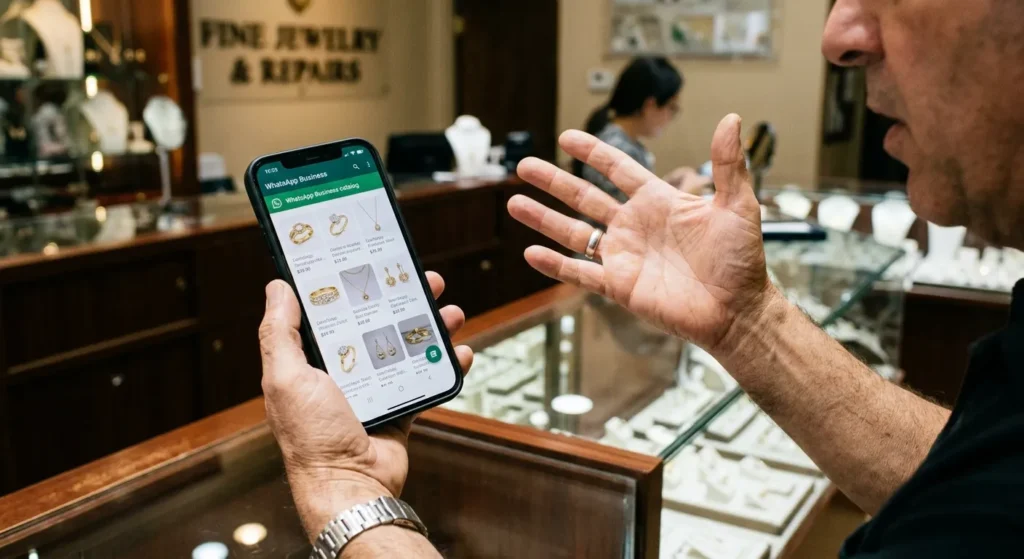
There is a workaround that many jewelry retailers in Muscat have adopted instead of building a proper online presence: the WhatsApp Business catalog. Send a message, receive a catalog of photos. Browse on your phone. Reply with what you want. Come to the shop to finalize.
It works — for existing customers who already have the shop’s number saved. It fails completely as a discovery tool. Here is why:
WhatsApp catalogs are invisible to Google. They cannot be indexed. They cannot be searched. They do not appear in any search result for any keyword. A jeweler with 500 product photos in their WhatsApp catalog has built a resource that only people who already know the business can access. For new customer acquisition — which is the entire purpose of marketing — WhatsApp catalogs contribute exactly nothing.
The false sense of digital progress is the real danger. When asked “do you have an online presence?” many Muscat jewelers now answer “yes, we have WhatsApp Business.” They genuinely believe this is sufficient. It is not. WhatsApp Business is a communication tool, not a discovery tool. It is the digital equivalent of having a beautiful printed catalog locked inside a drawer that only opens when someone already knows to ask for it.
The solution is not abandoning WhatsApp — it is excellent for customer service and relationship management. The solution is ensuring that the 500 products photographed for WhatsApp also exist on Google Business Profile as product listings and on a website as browsable inventory. The content already exists. It simply needs to be placed where search engines can find it.
What a Mother-in-Law Googles the Night Before the Gold Shopping Trip
Understanding the specific search moments in the Omani gold buying journey reveals exactly what content jewelry shops should be creating — and none of them are.
Moment 1 — Rate checking (daily, 124,000/month): “Gold price Oman today.” The live rate search. This is the entry point for every gold purchase. The jeweler who owns this search term owns the top of the funnel.
Moment 2 — Budget calculation (2-4 weeks before purchase): “كم سعر طقم ذهب ٢٢ عيار” (how much is a 22k gold set). The family is estimating how much gold their budget will buy at current prices. A page showing “Gold Set Guide — What Your Budget Gets You in 2026” with example sets at 1,000 / 3,000 / 5,000 / 10,000 OMR captures this research phase.
Moment 3 — Design research (1-3 weeks before purchase): “تصاميم ذهب عماني للعروس” (Omani gold designs for brides). The mother, sister, or bride herself is looking at styles. She is comparing Gulf designs versus Indian designs versus contemporary Italian styles. A jewelry shop with a gallery page organized by style — “Traditional Gulf Collection,” “South Indian Bridal Sets,” “Modern Minimalist” — matches this research intent directly.
Moment 4 — Shop comparison (3-7 days before purchase): “أفضل محل ذهب في مسقط” (best gold shop in Muscat). The family has decided to buy. They are choosing where. Google reviews, product photos, price transparency, and location convenience determine the winner.
Moment 5 — Day-of logistics (purchase day): “Gold shop open Friday Muscat” or “gold shop near me Al Khuwair.” Operating hours and proximity. The customer has money to spend today. Google Business Profile accuracy determines whether your shop or the competitor’s gets the visit.
Every one of these five moments has search volume. Every one is a content opportunity. Every one is currently uncontested by Muscat jewelers. The shop that creates content matching all five moments does not just capture one customer — it walks beside the customer through their entire decision journey, building familiarity and trust at each step.
SEO Services Packages
Google Business Profile Packages
Web Design Packages
TripAdvisor & Hospitality Packages
The arithmetic of Muscat’s jewelry market is this: significant physical presence, massive search demand, near-total digital absence. The result is a market where the majority of online gold shopping demand originating from Oman flows outward — to Dubai-based e-commerce, to international brand websites, to Amazon sellers — rather than staying within the city where the buyer lives, works, and could walk into a shop within fifteen minutes.
This is not a technology problem. The staff in these shops know their products better than any copywriter. The WhatsApp catalogs prove that product photography is already happening. The daily gold price check proves the customer base is already using Google as part of their buying process. Every raw ingredient for a successful online presence already exists.
What does not exist is the decision to connect these ingredients to the platform where 124,000 people are already looking every single month.
The jeweler in Muttrah with three generations of trust. The boutique in Al Araimi Boulevard with contemporary designs that photograph like magazine covers. The family shop in Ruwi that every South Indian bride visits before her wedding. The chain in Mall of Oman with national distribution but branch-level Google neglect.
Each has something the other doesn’t. All share the same absence on the one platform that matters more than any mall corridor in 2026.
The gold is in the case. The customers are on Google. The connection between them does not require new inventory, new staff, or new locations. It requires a decision that a shop’s online visibility deserves the same investment as its physical signage.
One decision. And then the 124,000 start finding you.
Reach out today:
📞 +968 7922 9535
📧 seoingcc@gmail.com
🌐 SEOinGCC
Because generations end and populations change. Oman’s expat community — which constitutes over 40% of the population — cycles every 3-5 years. Every departing customer must be replaced by a new one who has no family history with your shop and no way to find you except through Google. Your reputation is real. But a reputation that exists only in the memories of current customers does not acquire new ones.
The brand markets itself globally. Nobody markets your specific shop in your specific mall in Muscat. When someone searches “buy Longines Muscat,” the brand’s global website appears — but it does not tell the customer that your shop at Mall of Oman has the HydroConquest in blue dial in stock right now. Only your website and your Google profile do that. You are not competing with the brand. You are competing with the other retailer in the same city carrying the same brand.
The gold price page can be automated. A simple API integration pulls live gold rates and displays them without manual intervention. Product pages do not need daily price updates — they can show “Price based on daily gold rate + making charges. Contact for today’s price” with a click-to-call button. This approach provides transparency without requiring constant manual updates.
Social media shows your products to people who are scrolling. Google shows your products to people who are searching. The difference is intent. A person scrolling Instagram and seeing your gold set might think “nice” and keep scrolling. A person typing “buy 22k gold necklace Muscat” into Google is ready to spend money today. These are fundamentally different audiences requiring fundamentally different strategies.